

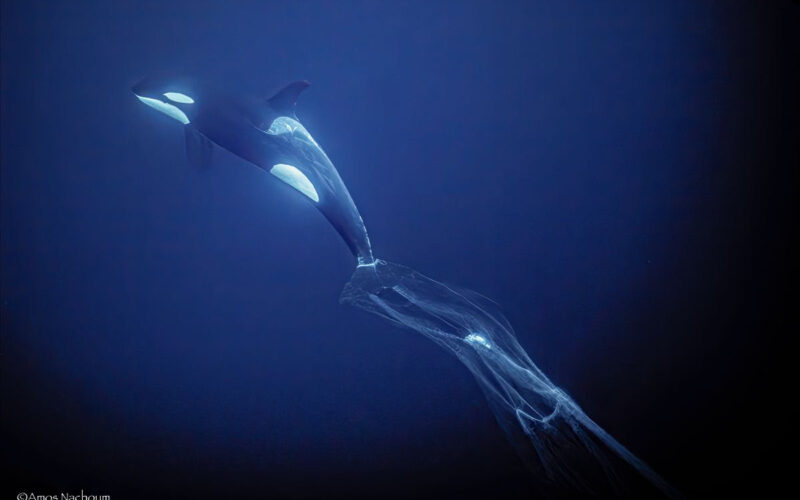
The story of Amos and the entangled orca:
The fjord lay still under the early winter sky, its waters reflecting the muted light of a sun too low to offer warmth. When Amos Nachoum, professional underwater photographer and ocean guide, slipped into the icy depths, encased in the drysuit, he was pressed into a heavy, icy silence. Ahead of him, a pod of orcas moved through the water – eight animals, gliding in a tight, deliberate formation.
Almost immediately, something felt wrong.
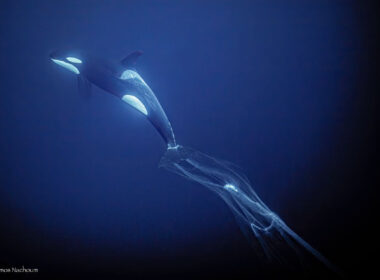
There was none of the curiosity, none of the playful interaction I had experienced so many times before. Instead, the pod kept its distance, their movements measured, almost solemn. As he sank to around 20 feet/ 6 meters and leveled out, the reason became painfully clear.
The pod were protecting an entangled orca.
A fishing net was wrapped tightly around its tail, rough fibers cutting deep into its flesh. The net trailed behind like a dead weight, a man-made anchor tethering an animal built for power and speed. Even in its slow, deliberate strokes, the toll it took on its energy and health was unmistakable.
Amos raised his camera, hands shaking, not from the cold, but from the gravity of the moment. Through the viewfinder, the contrast was stark: a sleek, vital body weighed down by crude synthetic fibers. Strength and suffering, survival and harm, frozen in a single frame.
There was nothing else that could be done to free the entangled orca. The team had no tools to cut the net free.
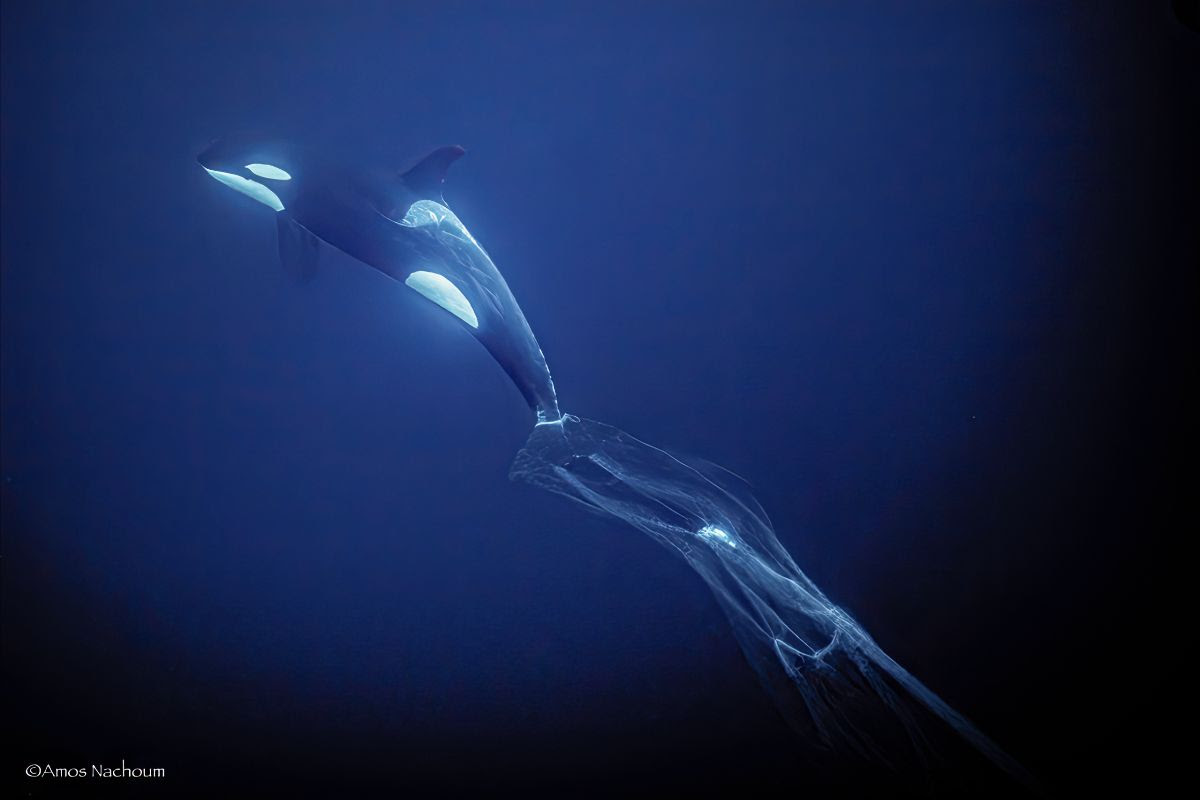
The Weight of Witnessing an Entangled Orca
That evening, back aboard the mothership, we reviewed the images together, Amos, Pierre, and Olav. To them, the net symbolized human carelessness, its presence in the fjord a violation of the natural world’s balance.
“We have to try to help,” Pierre said.
Pierre, Pierre Robert de Latour, is not only the teams dive master, but a renowned expert on orca behavior. They agreed to spend the next day searching for the pod, hoping for a chance to free the entangled orca.
The following morning, they searched for hours before finally finding them again. The injured orca was still there, moving more slowly than the day before. This time, Pierre and Amos entered the water without cameras, knives strapped and ready.
For 45 minutes at a time, we swam after them. Each kick felt heavier than the last as the cold crept deeper into my body. Amos’ breath sounded thunderous in the quiet water, amplifying the invisible barrier between us. The pod never broke formation. They stayed just out of reach, moving with purpose, protecting one of their own.
Again and again they dove, pushing themselves into the freezing depths. Each time, the orca slipped deeper into the fjord. The net, at least 30 feet long, was wrapped too tightly, the angles wrong, the animal too strong and too frightened to approach safely.
As the hours passed, exhaustion set in. The orca weakened. The teams attempts failed.
Eventually, heartbroken and shivering, they surfaced and climbed back into the skiff.
Want to learn more about Orca adventures? Discover here the Orcas of Tromso.
Safety First: When Helping Can Cause Harm
Encounters like this entangled orca raise an uncomfortable but crucial truth: the desire to help must never override safety, for humans or animals.
Even with training, experience, and the best intentions, approaching an injured or entangled marine animal is extremely dangerous.
Why intervention is so risky:
- Large marine animals, even weakened ones, can react unpredictably when stressed or in pain
- A single tail movement from an orca can cause serious injury.
- Nets, lines, and ropes can entangle rescuers just as easily as animals
- Improper cutting can worsen injuries or increase panic, leading to fatal outcomes
In many regions, attempting to free a marine mammal without proper authorization or equipment is illegal, precisely because well-meaning intervention can do more harm than good.
What to do instead:
- Document the situation clearly (photos, video, location, time)
- Report immediately to local authorities, marine mammal rescue organizations, or coast guards
- Keep distance and avoid pursuing or cornering the animal, especially something like an entangled orca.
- Educate others about ghost gear and ocean pollution
Professional rescue teams use specialized tools, boats, and coordinated strategies designed to minimize stress and maximize survival. Without those resources, sometimes the hardest, and safest, choice is to step back.
A Call to Responsibility
Back on board, reviewing the images once more, Amos’ realized they would never feel like a triumph. They were evidence, a reminder of the silent costs of human activity.
That net did not belong in the fjord. Yet there it was, dragging down one of the ocean’s most intelligent and graceful creatures. The pod’s behavior, surrounding and guarding the injured orca, revealed a level of social awareness and care that mirrored our own, and quietly challenged it.
This is not just the story of a single orca in distress.
It is a reflection of the imbalance we have introduced into the natural world. A symptom of a much larger problem, discarded fishing gear, lost nets, and human negligence, that continues to claim lives far from sight, far from headlines.
If there is responsibility to be taken from this encounter, it is this:
“Protecting the ocean starts long before we meet its consequences face to face.”
Because sometimes, bearing witness is all we can do and we should do everything in our power to ensure it doesn’t happen again and again.
Discover the amazing Big Animal Expeditions offered by Amos Nachoum and his team.
When encountering an emergency situation such as this one, you will be even more happy to be covered by DiveAssure comprehensive diving accident coverage. What are you waiting for get covered before your next trip.