
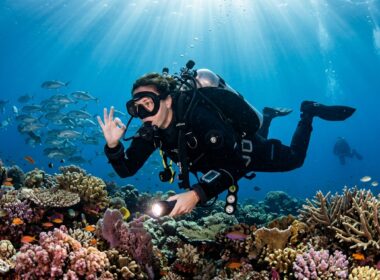
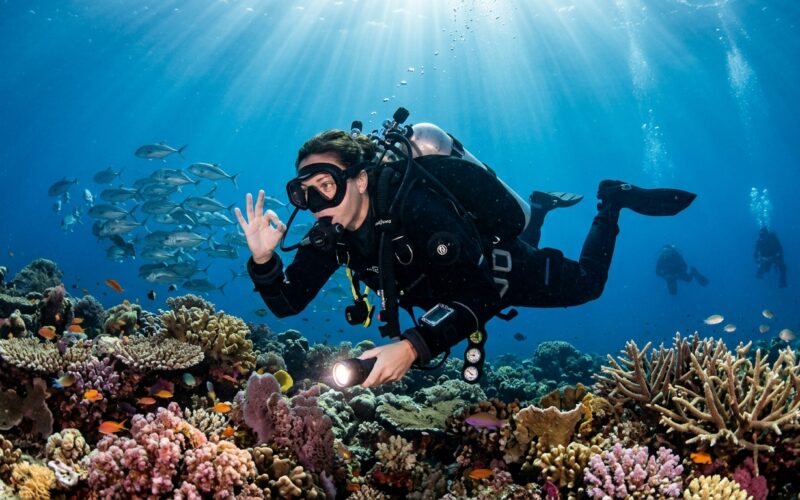
The boat engine cuts. Someone laughs. A regulator hisses. On the dive deck of a liveaboard somewhere in the Red Sea, a woman in a drysuit checks her twinset, calls out depth and runtime to her team, and rolls backward into the blue. She is the dive leader. She is also, on this particular trip, the captain. Nobody on board finds this remarkable anymore.
That, in itself, is the story.
For decades, the image of a diver was fixed in the public imagination: a man with a knife strapped to his calf, surfacing from somewhere mysterious. The reality has always been more interesting. Women have been diving professionally since the earliest days of the sport, and long before that in traditional diving cultures. Yet the stereotype lingered. Women in diving are no longer simply taking part; they are increasingly shaping the sport, leading expeditions, advancing marine conservation and inspiring the next generation of divers.
The ocean never cared who was breathing through the regulator. It just asked whether you were paying attention.
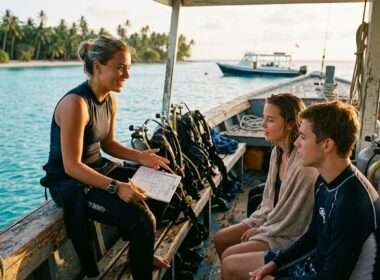
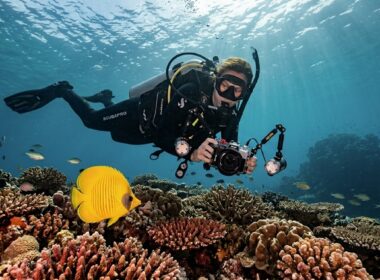
Step onto almost any dive boat today, and you’ll find women working across every area of diving. They’re teaching new divers, preparing for technical dives, exploring and mapping underwater caves, studying coral bleaching and capturing images that appear in leading magazines. Their presence reflects how much the diving community has evolved, with women increasingly visible across the sport, from recreational diving to exploration, science and photography.
From Bajau Freedivers to Expedition Leaders
The deeper you look, the longer the lineage becomes. In Japan and Korea, the Ama and Haenyeo have been freediving for shellfish and seaweed for more than a thousand years, often well into their seventies. In the Bajau communities of Southeast Asia, women dive on a single breath to depths that still astonish exercise physiologists. These were not hobbyists. They were professionals, breadwinners, and keepers of knowledge passed down through generations of women.
Modern recreational diving caught up slowly. When scuba exploded in popularity in the late twentieth century, early industry research consistently showed women as a minority of certified divers. That number has climbed steadily. Today, major training agencies report that women account for a substantial and growing share of new certifications worldwide, and in some regions they now outnumber men among entry-level students.
The shift is even more visible at the top of the sport. Women lead shark research expeditions in the Bahamas. They run technical training centers in Mexico. They skipper liveaboards in Indonesia. They design dive gear that, for the first time, is actually cut for a female body rather than scaled down from a men’s pattern. Representation at this level matters, because it tells the next generation of divers something simple: the door is open, and someone who looks like you is already inside.
What the Stereotypes Got Wrong
Ask any experienced instructor and they will tell you the same thing: on average, female students tend to arrive on the boat with less bravado and more willingness to listen. That is not a universal rule, and plenty of women dive with the same reckless confidence as anyone else. But the old assumption that women would struggle with the physicality of diving, with equipment, with staying calm under pressure, has aged very badly.
Air consumption is a good example. For years, the stereotype said women breathed through tanks too quickly to be serious divers. In practice, smaller body mass and lower oxygen demand often mean female divers finish a dive with more gas in reserve than their male buddies. On deep technical dives, that margin is not a party trick. It is a safety asset.
Then there is the mental side. Composure under stress is one of the most underrated skills in diving, and it is one that many female divers develop quickly. If you have ever watched someone talk a panicked student through a mask flood at six meters, you know exactly what calm leadership looks like. For anyone working through nerves of their own, our guide on pre-dive anxiety and how to cope with it is a good place to start, regardless of gender.
Leading Below the Surface, Inspiring Above It
Leadership in diving does not stop at the surface. Some of the most interesting conservation work happening right now is being led by women who dive and refuse to separate their sport from their responsibility to the ocean they love.
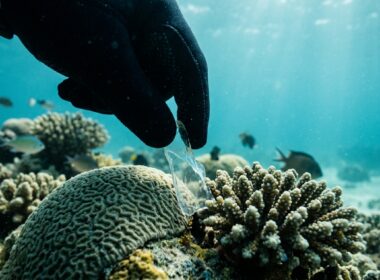
They are the ones running coral nurseries in the Caribbean, tagging manta rays in the Maldives, pulling ghost nets off reefs in the Mediterranean, and training local women in coastal communities to become dive guides and marine stewards in their own right. The work is unglamorous. It is also, quietly, reshaping what the dive industry values.
This matters for safety too. A more diverse dive community is a more honest one, more willing to talk openly about risk, about limits, about the stuff that used to get brushed off as weakness. Serious divers of every background now talk about preparedness as part of the craft, not an afterthought. That includes everything from gas planning to the mental checklist before a descent, and yes, it includes having proper coverage in place before you ever step on the boat. We built our dive membership around exactly that mindset, because being prepared is simply part of being a good diver.
Why the Risk Conversation Matters
Pretending diving is risk-free has never helped anyone. The sport has real hazards, and ignoring them is how small problems become serious ones. Here are a few situations that have historically been underestimated, especially for divers who were told to just push through:
- Pushing a dive plan to keep up with a buddy or group rather than calling it
- Diving unfamiliar gear that does not fit the body, from BCDs to drysuits
- Ignoring equalization pain or sinus issues to avoid “making a fuss”
- Traveling to remote dive sites without clear evacuation or chamber coverage
- Skipping a refresher after a long surface interval between dive trips
What experienced divers, male and female, actually do instead looks something like this:
- Plan the dive, dive the plan, and call any dive at any time without apology
- Invest in gear that fits properly, and test it in shallow water first
- Treat equalization, sinus, and ear issues as hard stops, not inconveniences
- Carry comprehensive dive travel coverage that includes hyperbaric treatment and evacuation
- Refresh skills before challenging trips, and brief new buddies honestly about experience level
None of this is gendered. All of it is professional. The best divers we know, across every background and discipline, treat the ocean with the same respect, and they prepare for the days that do not go as planned.
A Shared Ocean, A Shared Responsibility
The underwater world is not a stage. It is a shared space, and the growing visibility of female divers is less about replacing anyone than about completing a picture that was always incomplete. The ocean has room for recreational divers, freedivers, technical specialists, instructors, scientists, and professionals of every kind. We support all of them, because the sport is better when everyone has a seat on the boat and a tank on their back.
If there is a single lesson in watching women reshape this community, it is that competence has never had a gender. It is built dive by dive, debrief by debrief, mistake by mistake. The women leading expeditions today were beginners once, nervous on the giant stride, unsure of their buoyancy, learning to trust their equipment and themselves. The ones coming up behind them are watching, and the water is wide enough for all of them.
“The ocean does not ask who you are. It only asks if you are ready.”
Ready to dive wherever your next adventure takes you? Explore our dive and travel membership and dive with the confidence that comes from being properly prepared.
Summary
Women who dive are no longer a footnote in the sport. They lead expeditions, run dive centers, pioneer conservation projects, and shape how modern diving talks about safety, gear, and preparation. From the Ama freedivers of Japan to today’s technical instructors and marine scientists, female divers have always belonged in the water, and the industry is finally catching up. At DiveAssure, we support every diver, recreational, technical, and professional, with membership protection built around the real risks of the sport we all love.