

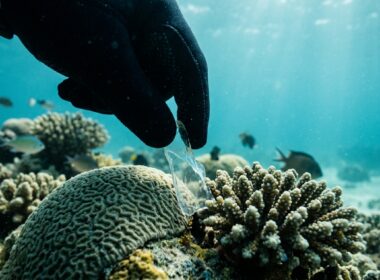

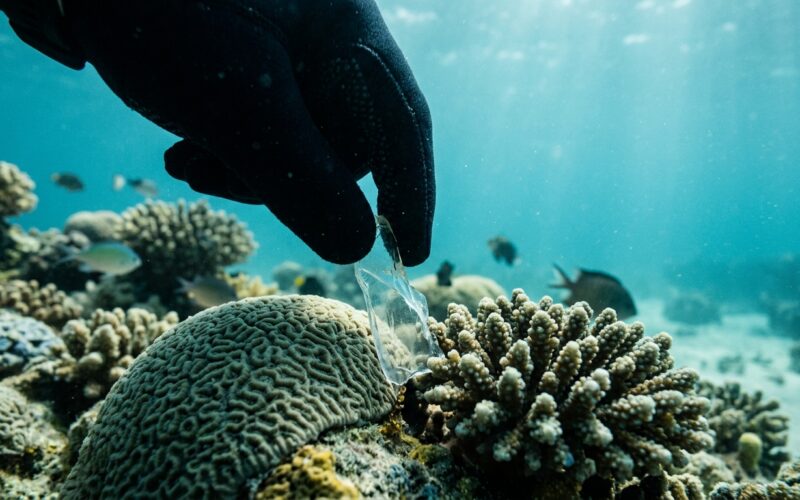
The first time I noticed it, I thought it was a tiny jellyfish. A pale fleck drifting past my mask at twenty meters, catching the light. I reached out with a gloved finger, and it did not pulse. It did not swim. It just hung there, weightless, until the current carried it toward a sea fan.
It was a sliver of plastic. Maybe from a bag, maybe from a bottle cap. Impossible to tell.
That was when microplastics stopped being something I simply read about and became something I could no longer ignore, something I saw on almost every dive, in almost every country.
Once you start noticing them, you cannot unsee them.
Ask any divemaster who has been working the same reef for a decade, and you will hear a version of the same story. The fragments are smaller now. They sit deeper in the sand. They collect in the folds of soft corals and in the little pockets between staghorn branches, places where fingers and nets cannot reach.
What Divers Are Actually Seeing
Microplastics are usually defined as plastic pieces smaller than five millimeters. From a diver’s eye, that covers a huge range, from obvious shards the size of a fingernail down to specks that look almost like sediment.
On a recent dive in the Philippines, I counted at least a dozen tiny blue and green fragments in a single square meter of sand near a seagrass bed. They were not floating. They were woven into the top layer of substrate, mixed in with shell fragments and bits of coral rubble. A pipefish was feeding right through them.
In the Red Sea, divers have been pulling long strands of synthetic fishing line out of table corals for years. What is newer is the fuzz. Fine, hair-thin fibers caught on the polyps, probably shed from clothing and nets, drifting out from distant laundries and ports.
In Indonesia, I have watched manta rays feed through visible slicks of particles at the surface during plankton blooms. The particles were not all plankton.
These are not isolated reports. Divers around the world are describing the same thing in different accents.
A Problem That Extends Beyond the Reef
Microplastics are small enough to be mistaken for food by filter feeders, larval fish, and plankton. From there, they move up the food chain, into the species we love to photograph and the ones that end up on dinner plates.
Here is why what we are seeing underwater is a bigger problem than it looks:
- Fragments absorb pollutants from the surrounding water, concentrating toxins
- Corals that ingest plastic particles can suffer tissue damage and reduced growth
- Fibers tangle in gills, guts, and reproductive tissues of small marine animals
- Once embedded in sediment, microplastics are nearly impossible to remove
- They travel on currents, so even remote dive sites are not spared
None of this is a reason to stop diving. It is a reason to dive with sharper eyes, and to carry what we see back to the surface with us.
The Side of Diving Safety We Divers Often Overlook
Here is something that does not get discussed enough. The same currents that carry microplastics across oceans also carry larger debris. Ghost nets, drifting ropes, half-sunk packaging. On conservation dives and cleanup dives, entanglement is a real risk, and so are cuts from barnacle-covered plastic and punctures from rusted metal.
If you plan to join cleanup dives, or if you simply find yourself freeing a turtle from a line more often than you expected, think about preparation the same way you think about buoyancy. Carry line cutters. Dive with a buddy who knows the plan. Check that your dive and travel coverage actually fits the kind of diving you are doing, including conservation work and remote travel. We built our membership around divers who go where the ocean needs them, not just where the postcards are.
If you want a wider primer on reducing your own footprint before and during trips, our piece on being a more sustainable diver is a good place to start.
What To Do Instead of Just Feeling Bad
- Carry a small mesh pouch clipped to your BCD for safe collection of fragments
- Never pull forcefully at plastic trapped in living coral, as this can cause further damage. If you can’t remove it safely, remove only what you can without harming the coral and leave the rest.
- Log sightings with citizen science platforms like Dive Against Debris
- Choose reef-safe, plastic-free sunscreens and solid toiletries for travel
- Rinse synthetic dive wear in a filter bag at home to catch shedding fibers
- Support operators who run regular cleanup days and refillable water stations
Reflection: The Reef Is Telling Us Something
There is a strange intimacy in finding a fleck of someone else’s shopping bag at forty meters, half a world from where it was dropped. The ocean is the ultimate connector. What we throw out does not go away. It gets smaller, drifts further, and eventually sits on a reef that someone will dive tomorrow.
Divers are, in a way, the ocean’s witnesses. We go to the places most people never see, and we come back with stories. The question is what we do with them.
Report what you see. Share it. Teach the newer divers on your boat to look for it. Push your home dive center to run cleanup days. And when you plan your next trip, think about how to travel in a way that leaves less behind than you brought.
At DiveAssure, we exist to let divers explore the world with confidence, and that includes the parts of the world that still need defending. We would rather be the membership that supports you on a conservation trip to a remote reef than the one you only think about when something goes wrong.
The reef is still worth saving, and we’re in a unique position to witness its beauty and protect it.
Travel knowing you are supported globally. Explore our dive and travel coverage and plan your next trip with us.
Summary
Divers around the world are seeing microplastics in the ocean firsthand, from fragments embedded in reef sand to fibers caught on coral polyps and particles drifting through feeding mantas. These particles harm marine life, absorb toxins, and travel far beyond their source. Divers can help by logging sightings, joining cleanup dives, and choosing reef-safe products and operators. At DiveAssure, we support divers exploring responsibly, so every dive gives something back to the ocean rather than taking from it.