

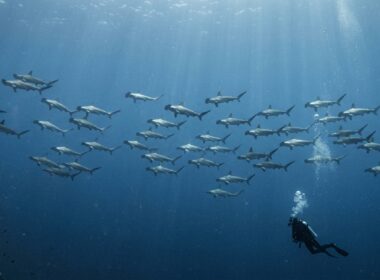
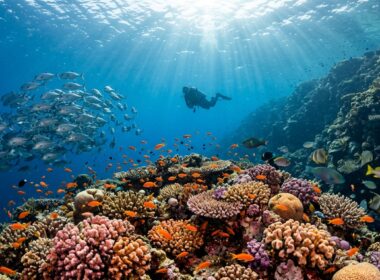
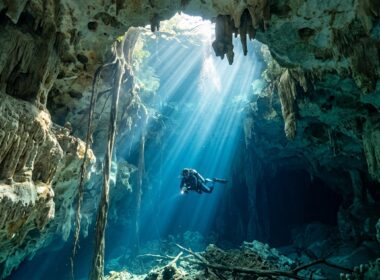
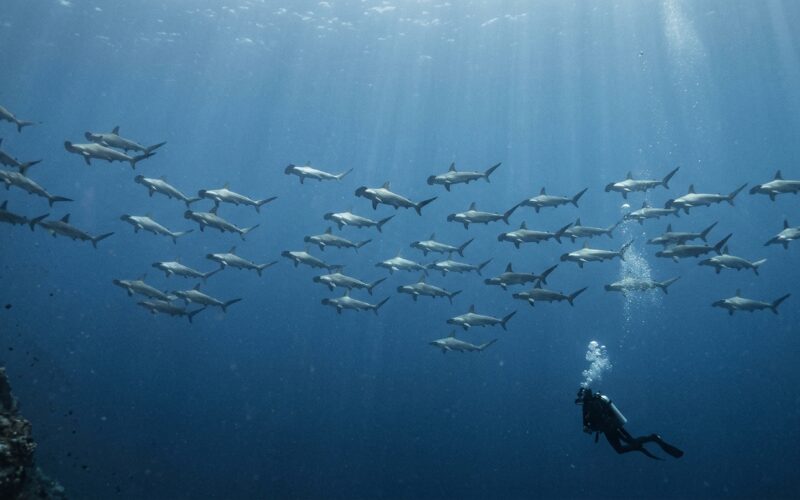
Diving the Galapagos Islands is not your average dive trip. It is a full-sensory experience where currents pull you into the action and marine life appears in staggering numbers. One moment you are gripping onto a rock, the next you are watching a long procession of hammerheads slide past, all facing into the current, spaced out like a squadron on patrol.
This is a destination that rewards preparation. It is not about comfort or easy drifting reefs, it is about entering one of the most biologically intense marine ecosystems on Earth.
Diving in the Galapagos Islands
The archipelago delivers encounters that feel almost unreal. Scalloped hammerheads gather in loose schools that stream along seamounts, always oriented into the current, often just beyond arm’s reach. Whale sharks, the largest fish in the ocean, pass through certain sites seasonally, dwarfing everything around them. Add to this marine iguanas feeding underwater, playful sea lions darting in and out of your bubble stream, and dense walls of jacks and barracuda.
Some of the most iconic dive sites in the world are found here. Darwin’s Arch, even following its partial collapse, remains a legendary reference point, and the surrounding seamount continues to deliver extraordinary aggregations of hammerheads and whale sharks. El Arenal on Isabela Island is one of the few places on Earth where you can watch marine iguanas grazing underwater, a genuinely surreal experience. Cabo Marshall, also on Isabela Island, is known for its manta rays, often seen circling the many cleaning stations. Punta Vicente Roca, on the northwestern tip of Isabela, brings cold upwellings and the possibility of encountering ocean sunfish, making it one of the more challenging and rewarding sites in the archipelago.
But what defines the experience just as much as the wildlife is the condition of the dives themselves. Strong currents are common, sometimes unpredictable, and often part of what brings in such incredible marine life. Many dives are drift-based or require negative entries and controlled descents.
Water temperatures vary significantly depending on currents, ranging from cool to surprisingly cold. A well-fitted exposure suit is essential. During the cooler season, a 7mm wetsuit is strongly recommended, and some divers opt for a drysuit at sites like Punta Vicente Roca where upwellings can bring temperatures down sharply. During the warmer months, a 5mm wetsuit is generally sufficient, though layering options are wise for repetitive dives.
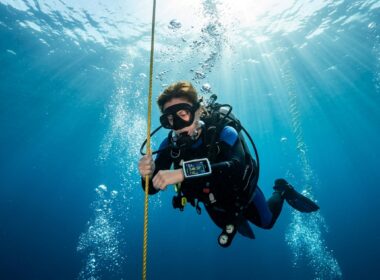
Carrying and knowing how to deploy a Surface Marker Buoy (SMB) is mandatory here. Given the drift diving conditions and strong currents, surfacing away from the boat is a real possibility, and your SMB is your primary means of being located. Do not dive here without one, and practice deploying it before you arrive. Reef hooks are also commonly used at high-current sites to hold position in the blue and observe marine life without fighting the current or disturbing the reef. Many operators will advise on their use, but it is worth familiarising yourself with the technique beforehand and confirming whether your operator permits and provides them.
In terms of experience, this destination is best suited to divers with a minimum of 50 to 100 logged dives, with demonstrable comfort in current, drift diving, and variable conditions. Divers who have not yet built this foundation are encouraged to work toward it before committing to a liveaboard itinerary. The ocean moves fast in the Galapagos, and situational awareness is not optional.
Because of these conditions, many divers feel more at ease knowing they have reliable travel and dive protection in place. Diving in remote locations like Darwin and Wolf means you are far from immediate medical facilities. Strong currents, deep profiles, and repetitive diving all add complexity. Having coordinated medical support and evacuation coverage through our dive and travel membership is not just a safety net, it is a practical part of planning a trip like this.
When and How to Travel to the Galapagos Islands
There is no single best time to visit, only different kinds of incredible. From June to November, cooler waters bring nutrient-rich currents and increase chances of seeing large pelagics, including whale sharks. Seas can be rougher during this period, and temperatures drop, so thermal protection becomes even more important. It is worth noting that September and October in particular can bring very high swells and consistently rough surface conditions. For anyone who is prone to seasickness, this season should be approached with caution or avoided entirely, as crossing between islands and riding out liveaboard nights can be genuinely challenging.
From December to May, conditions are calmer and warmer, with better visibility and more relaxed surface intervals. This period is often preferred by those easing into more advanced diving conditions, though big animal encounters still happen.
Most serious itineraries are liveaboard-based, especially for reaching world-famous sites like Darwin and Wolf Islands. These remote locations are where the action peaks, but they require commitment, both in time and diving skill.
Flights typically route through mainland Ecuador, followed by a domestic connection to the islands. Planning ahead is essential, especially for permits, park fees, and coordinating liveaboard schedules.
Not Just a Diving Destination
While the underwater world gets most of the attention, the Galapagos above the surface is equally compelling. Volcanic landscapes stretch across the islands, shaped by raw geological forces. Giant tortoises roam the highlands, and blue-footed boobies perform their unmistakable courtship dance along the shore.
Even surface intervals feel immersive. Watching sea lions nap on dock benches or spotting rays and reef sharks during the short boat ride between dives reinforces the feeling that, in the Galapagos, the wildlife experience never really stops.
It is also a place that quietly reinforces respect for nature. Strict conservation rules help preserve what makes the islands so extraordinary, and as visitors, we become part of that responsibility.
We Recommend
This is a destination best suited for confident divers who are comfortable with currents, depth, and changing conditions. If you are not there yet, it is a great goal to work toward. Build your experience with drift dives, improve your buoyancy, and get comfortable with quick descents and situational awareness.
Pack with intention. Bring a reef hook if recommended by your operator, ensure your exposure suit matches the season and the site, and never enter the water without a deployable SMB. Redundant essentials like a spare mask and multiple SMBs are worth the bag space. Most importantly, arrive with the right mindset. The Galapagos is less about control and more about adapting to the ocean on its terms.
Whether you are traveling for a once-in-a-lifetime liveaboard or adding the islands to a broader adventure, our membership helps you stay focused on the experience instead of the what-ifs. We support all divers, from recreational visitors to technical and professional divers building serious logbooks in places like this.
Relax and dive, we have got you covered.
Summary
Diving the Galapagos Islands is known for strong currents, big marine life, and unforgettable encounters at iconic sites like Darwin’s Arch, El Arenal, Cabo Marshall, and Punta Vicente Roca. Preparation is key, including a minimum of 50 to 100 logged dives, experience with drift diving, the right wetsuit thickness for the season, and a mandatory SMB. Timing matters too, with September and October bringing particularly rough conditions. With the right planning and support from a DiveAssure membership, divers can explore confidently and focus on the experience. It is one of the most rewarding dive destinations in the world for those ready for the challenge.