


Ask any experienced instructor what piece of surface equipment they would never leave the dock without, and most will give you the same answer: a well-maintained emergency oxygen kit. Yet many certified divers have never touched one, never seen one assembled, and would hesitate if a buddy surfaced confused, pale, and short of breath. That gap between what we carry and what we actually know how to use is where most preventable harm happens. Emergency oxygen for divers is not a specialist skill reserved for instructors or paramedics. It is a short, learnable, confidence-building course that every active diver should seriously consider.
In this guide we will walk through what emergency oxygen actually does for an injured diver, which situations call for it, what the training involves, how the equipment works, and how to make it part of your normal diving routine. Let’s take a look at why this one skill may be the most important non-diving skill you ever learn.
Why Emergency Oxygen Matters So Much in Diving
Diving injuries are rare, but when they happen they are time-sensitive. Decompression sickness, arterial gas embolism, near-drowning, and immersion pulmonary edema all share a common feature: the tissues are not getting enough oxygen, or the body is struggling to clear inert gas. High-concentration oxygen helps on both fronts. It increases the pressure gradient that drives nitrogen out of tissues and bubbles, and it supports organs that are under stress from hypoxia.
In practical terms, this means that the right oxygen delivered early, ideally within minutes, can reduce the severity of symptoms, improve the outcome of later hyperbaric treatment, and in many cases prevent a mild event from becoming a catastrophic one. It is not a cure. It is a bridge between the incident and definitive medical care. That bridge is often the difference-maker.
What Oxygen Does Not Do
It is just as important to understand the limits. Oxygen is not a reset button. A diver who feels tingling in their fingers after a square profile at 30 metres still needs evaluation and often recompression. Breathing oxygen on the boat does not mean the incident is over. In fact, one of the most dangerous mistakes we see is a diver feeling better after fifteen minutes on oxygen and declining further care. Symptoms can return hours later, sometimes worse. Oxygen stabilises, it does not resolve.
Common Diving Incidents Where Oxygen Is the Right Call
Knowing when to reach for the kit matters as much as knowing how to use it. Here are the scenarios where high-concentration oxygen is almost always indicated.
- Suspected decompression sickness, including joint pain, unusual fatigue, skin mottling, numbness, or confusion appearing after a dive
- Arterial gas embolism, often sudden and dramatic, with loss of consciousness, stroke-like symptoms, or collapse immediately after surfacing
- Near-drowning or water aspiration, even if the diver seems to recover quickly on the surface
- Immersion pulmonary edema, where a diver surfaces coughing, short of breath, sometimes with pink frothy sputum
- Any unresponsive or seriously injured diver, regardless of the suspected cause
If you are not sure whether oxygen is appropriate, the honest answer in nearly every diving context is: give it. The risks of high-concentration oxygen for a short period in an emergency are extremely low. The risks of withholding it from a bent diver are severe.
Who Can Be Trained, and What the Course Looks Like
One of the most reassuring things about oxygen provider training is how accessible it is. You do not need to be a divemaster. You do not need medical background. Most agencies, including SSI, SDI, PADI, DAN, and others, offer an emergency oxygen course that any certified diver can take, often from the age of twelve or fifteen depending on the agency. Non-divers can usually enrol too, which makes it a great course to do with a diving partner or family member who stays topside.
Courses typically run between four to eight hours. The format is a mix of classroom theory, equipment familiarisation, and hands-on practice with real cylinders and masks. You will leave with a certification card that is usually valid for two years before a refresher is recommended.
What You Will Actually Learn
- Recognising diving injuries where oxygen is indicated
- Assembling and disassembling a portable oxygen unit safely
- Choosing the right mask: non-rebreather, demand valve, or pocket mask with oxygen inlet
- Delivering oxygen to a breathing patient and to a non-breathing patient
- Managing a scene while someone else calls for help
- Handing over to professional responders cleanly, with useful information
The skills are not complicated. The confidence to use them under pressure is the real product of the course. You can read a manual in an hour. You cannot read your way into calm hands when your buddy is pale on the deck.
Understanding the Equipment
Oxygen kits for diving are purpose-built. They are compact, usually green-labelled, and designed to deliver medical-grade oxygen through more than one type of mask depending on the patient’s condition. You will learn to identify the different parts, making it easier to communicate what you need in an emergency and making the whole system feel less intimidating.
The Cylinder
Most dive boats carry an aluminium oxygen cylinder in the 240 to 680 litre range, equivalent to roughly a Jumbo D or M-sized tank. Capacity matters because an injured diver may need oxygen continuously for the entire transit to shore or to a chamber. A small cylinder empties fast at high flow rates, so bigger is generally better, especially on remote trips.
The Regulator
The oxygen regulator reduces cylinder pressure to a usable level and often includes both a constant-flow outlet and a demand-valve outlet. Constant flow pushes a steady stream of oxygen through a non-rebreather mask. The demand valve releases oxygen only when the patient inhales, which conserves gas and is ideal for a conscious, breathing diver.
The Masks
- Non-rebreather mask: covers the nose and mouth, has a reservoir bag, and delivers roughly 85 to 95 percent oxygen when run at 15 litres per minute. Used for breathing patients.
- Demand valve: a mouthpiece or mask the patient breathes from on demand. Delivers near 100 percent oxygen. Only works if the patient is breathing well enough to trigger it.
- Pocket mask with oxygen inlet: used for rescue breaths on a non-breathing patient, allowing you to add supplemental oxygen to your ventilations.
Where It Lives on the Boat
A kit that is buried under three bags of weights, bungeed behind the ladder, or stored in a locked cabinet with no clear key is not an emergency kit. It is a liability. Good dive operators keep oxygen visible, labelled, checked at the start of every trip, and briefed to every guest. If you notice during a boat briefing that no one mentions the oxygen, that is one of the quiet warning signs of a poorly prepared operation. We have written more about that in our article on spotting an unsafe dive center, and oxygen readiness is near the top of the list.
How to Actually Deliver Oxygen in the Field
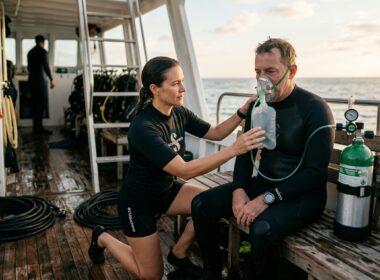
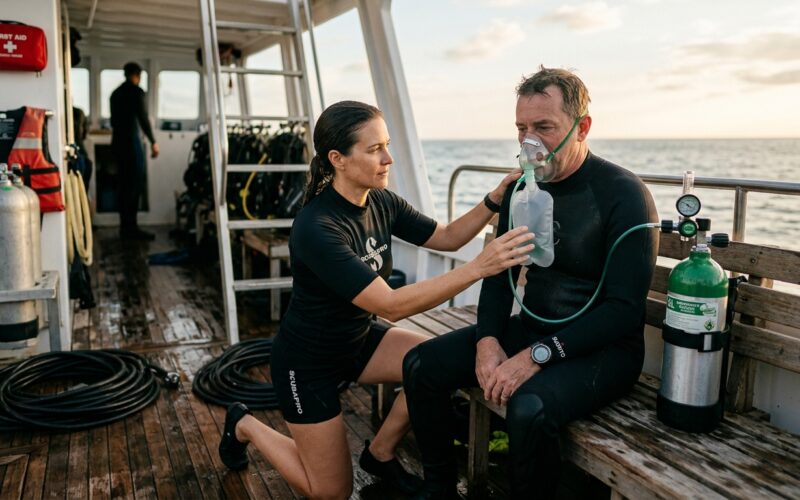
Let’s walk through a realistic sequence. Your buddy surfaces from a 28 metre dive, climbs the ladder, and within ten minutes complains of a strange ache in their shoulder and feels unusually tired. You suspect decompression sickness.
- Sit the diver down in a stable, shaded spot
- Send someone to call for emergency services and your coverage hotline
- Open the oxygen kit, check the cylinder pressure, and attach the regulator
- If the diver is alert and breathing well, offer the demand valve mouthpiece
- If the diver prefers or struggles with the demand valve, switch to a non-rebreather mask at 15 litres per minute
- Keep the diver hydrated with water if they can drink, and keep them lying flat or in a position of comfort
- Monitor breathing, responsiveness, and symptoms continuously
- Do not remove the oxygen because they feel better. Keep it running until professional help takes over or the cylinder runs out
This is also the moment where good preparation off the water pays off. Having our DiveAssure membership details saved on your phone, including the 24/7 emergency hotline, means that evacuation logistics, chamber coordination, and medical costs are being handled while you focus entirely on your buddy. You can read more about this in our guide to diving emergency preparedness.
Common Mistakes We See on Dive Boats
Even on well-run boats, oxygen use goes wrong in predictable ways. Being aware of these helps you avoid them.
Hesitating Because the Symptoms Seem Mild
Fatigue after a dive is normal. Unusual fatigue is not. Divers routinely downplay symptoms because they do not want to ruin the day, embarrass themselves, or admit something went wrong. If you are the trained responder, trust the signs, not the self-assessment.
Using the Wrong Mask for the Situation
A demand valve on an unresponsive diver delivers nothing. A simple surgical-style mask on a bent diver delivers far too little oxygen to help. Match the mask to the patient’s condition.
Running the Cylinder Dry Too Early
At 15 litres per minute, a small cylinder can be empty in under 30 minutes. On a remote site, that is often not enough. Know your kit’s capacity before you need it, and plan for continuous flow during transport.
Not Briefing the Buddy or Boat Crew
If only one person on the boat can find and assemble the oxygen, that person is a single point of failure. The best teams brief every guest at the start of the day on where the kit lives and who is trained.
Oxygen Training and Being a Better Buddy
There is a quiet confidence that comes with knowing you can respond to a bad day. It changes how you dive with newer partners. It changes how you choose operators. It changes how you handle those small moments on the surface when something feels off. Being the person who can act is part of what it means to be a dependable buddy, something we explored more fully in our piece on how to become an excellent dive buddy.
It also strengthens the whole dive community. When more divers on a boat are oxygen-trained, response times shrink, mistakes get caught, and the collective skill level of the trip rises. Technical divers, freedivers, and dive professionals all benefit from this shared baseline. Our coverage at DiveAssure is built to support divers across every discipline, from recreational travel divers to tech teams running decompression profiles, and oxygen training is one of the common threads that keeps all of them safer.
Travel, Remote Sites, and the Oxygen Reality Check
At home, help is often minutes away. On a liveaboard in the Red Sea, in the Raja Ampat passages, or on a shore dive in a remote part of the Caribbean, help can be hours or even a full day away. The oxygen you have on board may be the only medical intervention available between the incident and definitive care.
This is where membership-level preparation really earns its place. Knowing in advance how evacuation works from the site you are visiting, which chamber is operational, and who to call changes the entire tempo of an emergency. We have seen this play out in real stories like our account of a diving accident in Belize, where the combination of early oxygen, calm response, and coordinated evacuation shaped the outcome.
Freedivers Are Not Exempt
Oxygen training is often associated with scuba, but freedivers face their own oxygen-related risks, especially shallow water blackout and loss of motor control. A trained buddy with oxygen on the surface can make a decisive difference during recovery. If you freedive, this course is just as relevant to you, and pairs well with the guidance in our top safety tips for freedivers.
Choosing a Course and Keeping Skills Fresh
When you look for a course, choose one that includes real hands-on time with assembled kits, not just a video and a quiz. Ask whether you will practise with both demand valves and non-rebreather masks. Ask whether the instructor uses realistic scenarios. A good oxygen course should leave you tired, slightly stretched, and genuinely confident.
Refreshers Matter
Skills fade. Two years is the common refresher window, but if you dive infrequently, consider a self-review every season. Open your own kit at home or on the boat. Assemble it, time yourself, run through the mask options, and pack it back exactly as you found it. Five minutes once a month keeps the muscle memory alive.
Travel with Your Own Knowledge, Not Your Own Cylinder
You will not usually travel with an oxygen cylinder, as airlines rightly restrict them. What you travel with is the skill. On arrival, check what the operator carries, confirm it is full, and know where it lives. If the answer is vague, that is useful information too.
Packing Tips and Pro Tips
A few habits that experienced divers build around oxygen awareness:
- Save the DiveAssure 24/7 emergency number in your phone before every trip, and share it with your buddy
- Carry a small waterproof card with your medical information, allergies, and emergency contact
- Keep a basic first-aid pouch in your dive bag, including a CPR face shield
- Refresh your rescue diver and oxygen provider certifications on overlapping schedules so neither one lapses
- If you own a kit, service it annually and keep the cylinder in current hydro test
These are small acts of preparation. None of them cost much. All of them pay back the first time something goes sideways.
Conclusion
Oxygen training is one of those rare skills that is cheap, short, broadly applicable, and genuinely life-saving. It takes a single day. It stays with you for a lifetime of diving. It makes you a better buddy, a sharper traveller, and a more useful presence on any boat you ever step onto. If you dive regularly and you have not taken an emergency oxygen course yet, this is the sign to book one. Pair that training with solid coverage so that when the oxygen is flowing, the next steps, evacuation, treatment, and the financial side, are already being handled in the background. You can learn more about why that layered preparation matters in our overview of diving accident insurance.
Need coverage for your upcoming trip? Get covered here.
Happy diving, and may your next adventure be your best one yet!
Summary
Emergency oxygen for divers is one of the most important first-response tools in any diving incident, from suspected decompression sickness to near-drowning. Any certified diver can and should take an oxygen provider course, usually a short one-day class that covers assembly, delivery masks, and safe handling. Training saves lives in the critical minutes before professional help arrives. At DiveAssure, we encourage every diver to pair this skill with reliable coverage so help, evacuation, and treatment are organised the moment an incident begins.